

Rehabilitation is a critical phase in the healthcare continuum, bridging the gap between medical intervention and functional restoration. For individuals recovering from orthopaedic surgeries, neurological events such as strokes, acute sports injuries, or age-related mobility decline, the path to recovery requires specialized, scientifically validated support.
At SHYICARE, our engineering and clinical teams specialize in designing medical-grade rehabilitation products. These tools accelerate recovery, prevent secondary complications, and empower individuals to reclaim their physical independence safely and effectively.
1. Introduction to Rehabilitation Products & Their Clinical Role
Rehabilitation products—often referred to as rehabilitative appliances or assistive technology—encompass an extensive ecosystem of medical devices, mobility aids, and therapeutic instruments tailored to restore physical function. In clinical rehabilitation centers, physical therapy clinics, and home-care settings, these tools serve as indispensable instruments for therapeutic intervention.
According to clinical guidelines from leading physical therapy associations (such as APTA and AOTA), the therapeutic importance of specialized recovery gear relies on several key biomechanical and physiological mechanisms:
· Targeted Functional Recovery: Post-surgical interventions—such as total knee arthroplasty (TKA) or rotator cuff repairs—require precise, controlled movement. High-density resistance bands and joint-mobilization tools facilitate targeted muscle activation without overloading healing tissues.
· Neuromuscular Re-education: Stroke survivors often experience hemiparesis or impaired proprioception. Utilizing textured balance pads and gait trainers stimulates neuroplasticity, retraining the brain and central nervous system to execute motor functions.
· Secondary Complication Prevention: Prolonged immobility risks joint contractures, muscle atrophy, and deep vein thrombosis (DVT). Assistive positioning devices and passive motion tools keep soft tissues pliable and promote healthy venous blood flow.
· Gait Stabilization & Fall Mitigation: Balance deficits in elderly populations significantly elevate fall risks. Ergonomic walkers and rollators widen the base of support, stabilizing center-of-gravity shifts during locomotion.
Clinical Insight: "In our daily practice, we observe that patients using ergonomic, height-calibrated physical therapy equipment achieve functional milestones up to 25% faster while reporting lower post-exercise pain scores."
2. Comprehensive Classification of Rehabilitation Equipment
To address distinct clinical demands, rehabilitative tools are categorized into three core functional areas:
Comparison Matrix: Rehabilitation Equipment Categories
|
Category |
Primary Indications |
Key Product Examples |
Primary Biomechanical Benefit |
|
Mobility Aids & Locomotion |
Post-op lower limb surgery, stroke, severe weakness, age-related instability |
Rollators, Quad-canes, Forearm crutches, Patient transfer boards |
Widens base of support, reduces weight-bearing joint stress |
|
Daily Living & Assistive Devices (ADLs) |
Arthritis, Parkinson’s disease, hip replacement, spinal stiffness |
Adaptive silicone utensils, Sock aids, Reachers, Anti-microbial shower chairs |
Eliminates dangerous joint bending angles, restores autonomy |
|
Physical Therapy & Exercise Gear |
Post-injury tissue rehab, core stabilization, strength conditioning |
Elastomer resistance bands, Closed-cell balance pads, High-density foam rollers |
Stimulates muscle fiber activation, improves proprioception and balance |
A. Mobility Aids & Locomotion Tools
· Walkers and Rollators: Heavy-duty aluminium rollators featuring dual-braking systems, padded seating, and swivel wheels offer continuous balance support.
· Ergonomic Canes & Crutches: Height-adjustable forearm crutches and quad-canes equipped with shock-absorbing rubber ferrules reduce impact stress on wrist and shoulder joints.
· Patient Transfer Devices: High-tensile transfer belts with reinforced handles and low-friction glide boards allow caregivers to safely pivot patients between beds, wheelchairs, and vehicles.
B. Daily Living & Assistive Devices
· Adaptive Utensils & Tableware: Weighted, bendable forks and spoons with thick silicone handles enable individuals with tremors or reduced grip strength to feed themselves independently.
· Reachers & Dressing Aids: Long-handled jaw reachers and sock aids assist users with hip replacements or spinal stiffness in dressing without exceeding safe bending limits.
· Bathing & Hygiene Aids: Anti-microbial shower chairs, wall-mounted suction grab bars, and angled bath benches significantly lower slip hazards in wet environments.
C. Physical Therapy Equipment & Exercise Gear
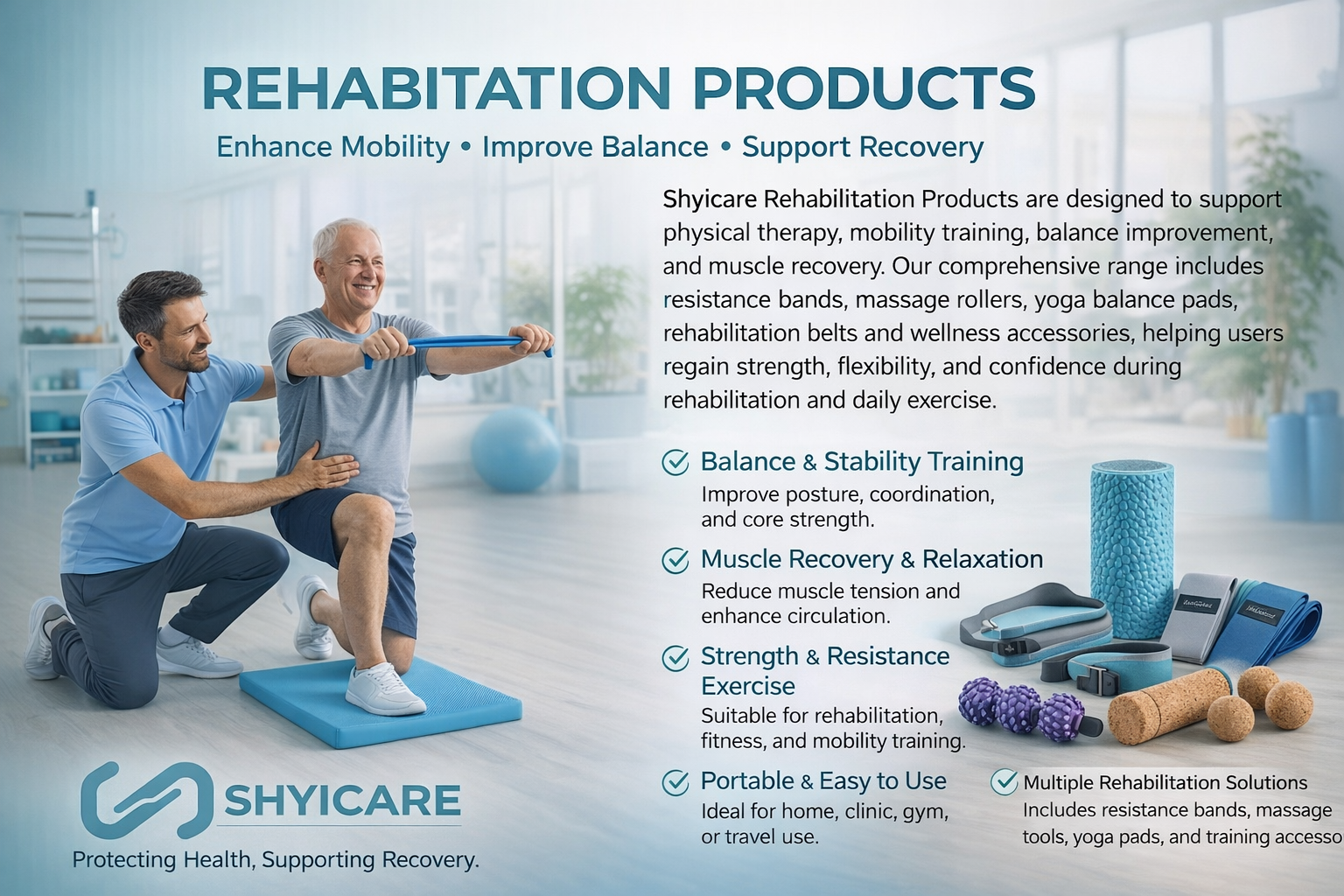
· Progressive Resistance Bands: Latex-free elastomer bands with color-coded resistance levels allow for incremental strength training in both upper and lower extremities.
· Balance & Stability Pads: Closed-cell foam balance pads create controlled instability, challenging core musculature and ankle stability.
· Myofascial Recovery Tools: High-density foam rollers and trigger-point massage balls release tight muscle fascia and enhance localized circulation post-exercise.
3. Step-by-Step Guide: How to Choose the Right Rehabilitation Products
Selecting appropriate rehabilitative appliances requires a systematic approach balancing clinical requirements, safety standards, and environmental suitability.
Step 1: Secure a Professional Clinical Assessment
Always consult a licensed physical therapist, occupational therapist, or physician before purchasing equipment. A professional evaluates specific biomechanical parameters—such as range of motion (ROM), weight-bearing allowance, and cognitive function—to prescribe exact equipment dimensions and features.
Step 2: Prioritize Build Quality and Safety Engineering
Safety is paramount in load-bearing mobility aids and therapy equipment. Prioritize products built with aircraft-grade aluminium, non-toxic materials, and non-slip rubber bases. SHYICARE products adhere to international ISO and CE quality standards, incorporating reinforced welding, anti-tipping geometries, and heavy-duty hardware designed to withstand repeated therapeutic use without structural failure.
Step 3: Verify Adjustability and Weight Capacity Limits
Human bodies and recovery stages vary. Ensure products offer versatile adjustability:
1. Height Calibration: Canes and walkers must adjust so that handles align precisely with the user’s wrist crease when standing upright, maintaining a 20-to-30-degree elbow flex.
2. Weight Ratings: Always check maximum static and dynamic weight capacities on all assistive devices to prevent structural collapse.
3. Progressive Difficulty: Resistance tools should offer clear color-coded resistance levels to accommodate gradual strength gains over weeks of therapy.
Step 4: Evaluate Environmental Fit and Portability
Consider where the equipment will function. For compact residential spaces, choose lightweight, tool-free foldable rollators and portable physical therapy equipment like SHYICARE compact balance pads and roll-up therapy bands that store easily and travel conveniently.
4. Proper Usage, Maintenance, and Maximizing Recovery Outcomes
Acquiring high-grade recovery gear is only the first step; proper execution and routine maintenance are necessary to ensure user safety and optimal therapeutic outcomes.
Best Practices for Clinical Usage
Execute rehabilitation routines under strict adherence to physical therapy protocols. For instance, when using a walker, patients must step into the frame rather than pushing it too far ahead, preventing forward trunk leaning. When using resistance bands, movement should remain controlled during both concentric (pulling) and eccentric (releasing) phases to maximize muscle fiber activation and prevent sudden joint recoil.
Preventive Inspection & Equipment Maintenance
Regular maintenance extends equipment lifespan and guards against accidental injury:
· Visual & Structural Checks: Weekly checks should be conducted on rubber cane tips (ferrules) for thread wear, mobility rollator brakes for tension, and resistance bands for micro-tears or discoloration. Damaged rehabilitative appliances must be retired immediately.
· Hygiene and Sanitization: Clean equipment regularly using non-corrosive, hospital-grade disinfectant wipes to prevent bacterial accumulation, especially on foam handles and vinyl seat cushions.
· Optimal Storage: Store elastic and soft-foam products away from direct sunlight, extreme heat, or moisture to prevent material degradation.
How should I choose the right rehabilitation products for my specific recovery needs?
Begin with an evaluation by a licensed physical therapist or healthcare provider. Key selection criteria include your specific physical limitations, product load-bearing capacity, height adjustability, non-slip safety features, and home spatial constraints. Trusted brands such as SHYICARE provide comprehensive assistive devices and mobility aids suitable for both clinical rehabilitation and home recovery.
Are SHYICARE rehabilitation products safe for home physical therapy?
Yes. SHYICARE designs user-friendly, durable, and highly stable physical therapy equipment specifically created for safe home physical therapy, daily living assistance, and outpatient care under professional guidance.
Can I perform rehabilitation exercises independently without professional supervision?
Basic daily living aids (such as reachers) and low-impact recovery gear (such as light resistance bands) can be used independently once your therapist trains you on proper mechanics. However, initial usage of weight-bearing mobility aids or post-surgical rehab equipment should always be supervised or prescribed by a healthcare specialist.
How do I ensure my rehabilitative appliances remain safe and durable over time?
Conduct weekly safety checks on structural joints, brake cables, and rubber bases. Clean surfaces after use with mild disinfectants, and store elastic bands and foam products in cool, dry areas away from direct sunlight to preserve structural integrity.
What warranty and support options come with SHYICARE equipment?
SHYICARE products come with a standard 12-month manufacturer warranty covering structural frame defects. Dedicated customer support and replacement components (such as rubber feet and brake pads) are available directly through our online portal.