

1. Introduction to Surgical Mattresses and Their Clinical Importance
In high-stakes surgical environments, focus naturally centers on surgical precision and vital sign monitoring. However, the foundational support surface—the surgical mattress—plays an equally critical role in patient outcomes. Rather than being simple comfort padding, a medical-grade operating table pad is an engineered therapeutic device designed to maintain skin integrity and anatomical alignment during motionless procedures.
When patients undergo general anesthesia, neuromuscular blockade eliminates natural protective reflexes and postural shifts. Unmitigated interface pressure against hard operating surfaces rapidly compresses microvascular capillary beds. If capillary perfusion pressure drops below critical thresholds for over two hours, local tissue ischemia, hypoxia, and permanent cell death begin. This triggers Hospital-Acquired Pressure Injuries (HAPIs) over vulnerable anatomical areas.
Additionally, procedures requiring extreme patient positioning—such as steep Trendelenburg or prone positioning—introduce severe shearing and friction forces. Modern surgical care demands proactive risk mitigation. Advanced medical padding options, such as the SHYICARE Surgical Mattress, serve as a vital line of defense. By serving as an effective pressure relief surface and dissipating lateral shear stress, these solutions prevent tissue ischemia and safeguard long-term patient recovery.
2. How Do I Choose a Surgical Mattress? (4 Core Technical Criteria)
Selecting an optimal medical mattress requires balancing clinical efficacy, patient safety, and operational durability. When hospital procurement committees, biomedical engineers, and OR managers ask, "How do I choose a Surgical Mattress?", they should evaluate four core technical criteria:
|
Evaluation Metric |
Technical Requirements & Standards |
Clinical Benefit |
|
Pressure Redistribution |
Multi-layered viscoelastic memory foam or gel-hybrid core matrices. |
Prevents bottoming out, dynamically conforms to body contours, and offloads bony prominences. |
|
Fluid Impermeability |
Ultrasonic welded/sealed seams with non-porous PU liquid barrier coatings. |
Blocks fluid ingress and cross-contamination while preventing internal foam degradation. |
|
Radiolucency |
100% radiolucent, metal-free structural materials. |
Ensures artifact-free fluoroscopy, C-arm, and X-ray imaging without patient repositioning. |
|
Dimensional Fit |
Precision OEM/ODM sizing compatible with universal OR table brands. |
Eliminates hazardous gaps and prevents intraoperative patient sliding. |
3. Key Features and Material Innovations in Modern Surgical Mattresses
Recent advancements in polymer science have transformed contemporary operating table padding into high-performance protective systems. Understanding these material innovations enables healthcare buyers to make evidence-based purchasing decisions:
Multi-Density Viscoelastic Cores
Leading choices, such as the SHYICARE Surgical Mattress series, employ a dual or triple-layer foam matrix. The top layer features high-density, temperature-sensitive viscoelastic memory foam that softens upon contact with body heat, acting as a tailored pressure relief surface that molds precisely to the patient's anatomy. The firmer base layer provides structural integrity, preventing heavy anatomical zones from sinking onto the rigid table base.
Advanced Biocompatible and Anti-Static Covers
The outer membrane of the support surface interacts directly with delicate patient tissue. Premium mattresses feature multi-stretch polyurethane (PU) fabrics engineered with specific clinical properties:
· Biocompatibility: Certified ISO 10993 compliant, ensuring the material is non-sensitizing, non-irritating, and free of latex and phthalates.
· Anti-Static Dissipation: Formulated with anti-static properties to safely bleed off electrical charges, vital in oxygen-enriched OR environments.
· Shear Reduction: Multi-directional stretch fabrics move synchronously with patient tissue during table rearticulation, preventing epidermal tearing.
Disinfection Resistance
Busy surgical centers require rapid room turnover. Modern operating table pad covers withstand frequent wiping with harsh, hospital-grade chemicals—including quaternary ammonium, hydrogen peroxide, and sodium hypochlorite solutions—without cracking or losing flexibility over time.
4. Conclusion and Choosing the Right Partner for Your Hospital
Upgrading your hospital's surgical support surface units is a direct, cost-effective strategy for elevating patient care standards while mitigating financial liability associated with preventable Hospital-Acquired Pressure Injuries (HAPIs). A single severe pressure injury can add tens of thousands of dollars in extended hospital stays and wound treatment, far exceeding the investment in a premium operating table pad.
By integrating advanced pressure-relief technology, fluid-impermeable safety construction, and custom engineering, SHYICARE delivers a reliable surgical mattress line tailored to modern clinical demands. Whether you require a full replacement pad or a specialized overlay, partnering with SHYICARE ensures surgical teams are equipped to protect patients during complex procedures.
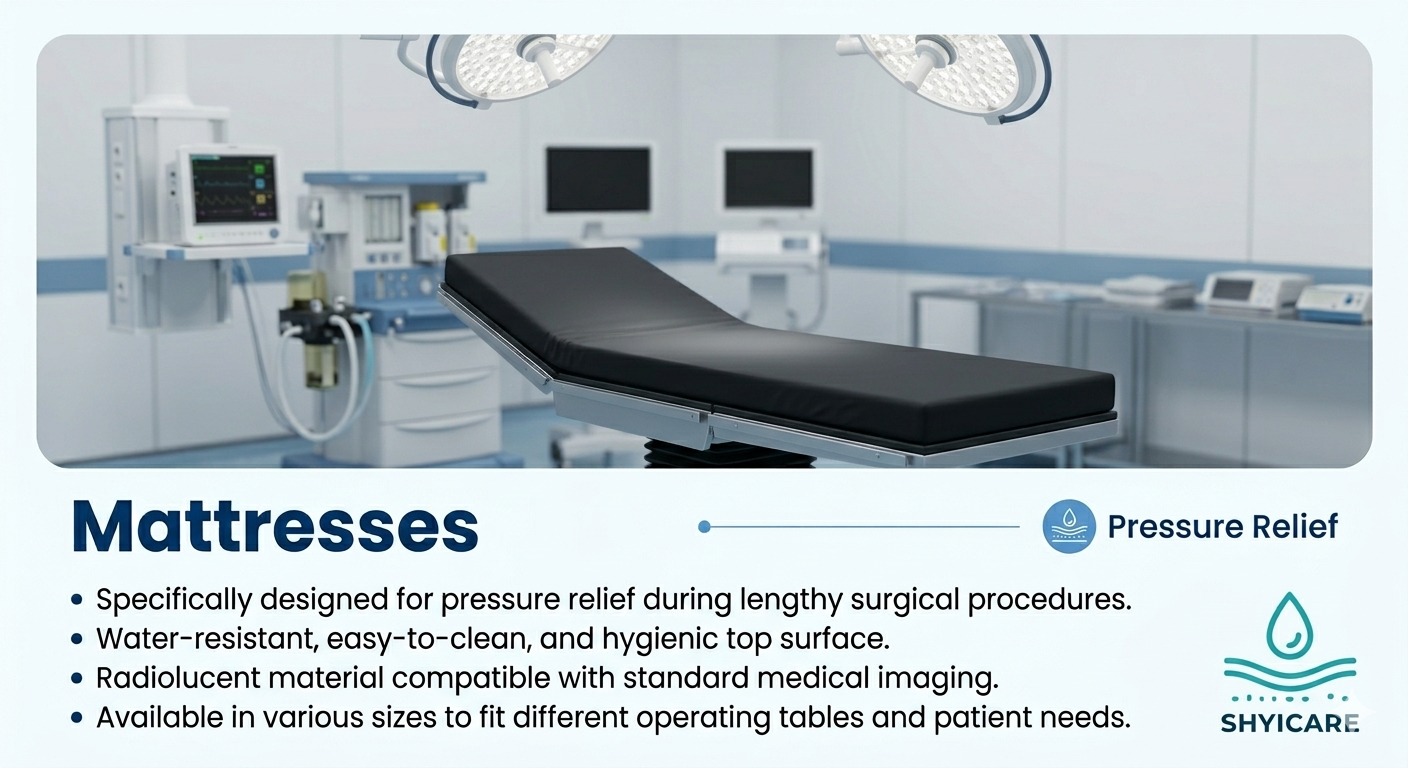
How do I choose a surgical mattress for long OR procedures?
Focus on a multi-layer pressure relief surface made of viscoelastic memory foam cores that dynamically redistribute weight. Ensure the cushioning pad cover features multi-directional stretch to reduce shear forces and ultrasonic-sealed seams to block fluid ingress during extended surgeries.
Are SHYICARE surgical mattresses compatible with X-ray and C-arm imaging?
Yes. SHYICARE operating table pad products utilize 100% radiolucent, metal-free materials that allow clear, artifact-free intraoperative imaging without requiring patient movement.
What material is most effective for preventing pressure ulcers on the operating table?
High-density, temperature-sensitive viscoelastic memory foam combined with a bi-elastic, low-friction polyurethane cover is clinically recognized as the gold standard support surface for lowering interface pressure and minimizing tissue shear.
How should a surgical mattress or overlay be cleaned between surgeries?
Wipe the waterproof cover thoroughly using hospital-approved disinfectant wipes (e.g., diluted bleach or quaternary ammonium). Ensure the surface is completely dry before placing clean surgical linens or positioning devices.