

Finding the right headrest is one of the most effective, scientifically backed ways to transform your sleep quality and safeguard your long-term spinal health. While many people focus entirely on picking the right mattress, your pillow accounts for roughly 25% to 30% of your body's contact surface during rest. Using an incompatible cushion can cause neck flexion misalignment, contributing to chronic neck strain, morning stiffness, tension headaches, and nocturnal awakenings.
If you find yourself asking, "How do I choose a pillow?", you are not alone. According to ergonomic physical therapy standards, an ideal pillow maintains a neutral spine—keeping your forehead, chin, sternum, and neck aligned parallel to the mattress. Brands like SHYICARE focus on integrating advanced material science with anatomical principles to deliver targeted cervical support and superior sleep comfort.
1. Ergonomic Science: Why Neck Alignment Matters
Sleep is a vital physiological requirement. Maintaining optimal cervical alignment ensures uninterrupted neurological and musculoskeletal recovery. Your neck consists of seven cervical vertebrae (C1-C7) forming a natural lordotic curve (30°–40°).
When your headrest is too thick, your upper spine experiences forward flexion, stretching posterior neck muscles and compressing your airway. Conversely, an overly flat pillow causes hyperextension, compressing facet joints.
A medical-grade cushion fulfills two key roles:
1. Pressure Redistribution: Cradling the cranium to eliminate occipital pressure spikes.
2. Structural Cervical Support: Filling the anatomical void behind the neck to maintain a neutral spinal column.
Because body weight, shoulder width, and mattress firmness alter how far your body sinks, a single pillow design cannot suit everyone. For instance, a softer mattress lets your torso sink deeper, requiring a lower pillow loft than a firm mattress.
2. Pillow Types and Material Physics
Modern sleep technology extends far beyond simple polyester or down fills. Below is a breakdown of core materials based on clinical testing:
|
Pillow Type |
Key Characteristics & Physics |
Ideal Candidates |
Ergonomic Considerations |
|
Ergonomic & Contour Memory Foam |
High-density viscoelastic foam; anatomical central depression and dual-height cervical rolls. |
Individuals with neck strain, chronic stiffness, or post-injury recovery needs. |
Maintains precise alignment; prevents excessive cervical tilting throughout the night. |
|
Phase-Change Cooling Gel |
Open-cell memory foam integrated with thermal-conductive phase-change materials (PCM). |
Hot sleepers, night sweat sufferers, or side sleepers needing firm support. |
Dissipates surface body heat, reducing local microclimate skin temperature by 1.5°C-3.0°C. |
|
Interactive Smart Pillows (e.g., SHYICARE Air Cozy) |
Embedded non-invasive piezoelectric sensors tracking real-time sleep architecture, HRV, and movement patterns. |
Tech-focused users, sleep hygiene improvers, and snoring-sensitive sleepers. |
Syncs data via app without wearable discomfort; offers real-time micro-airbag loft adjustments. |
3. How Do I Choose a Pillow? (A Step-by-Step Selection Guide)
Follow this 3-step decision matrix derived from physical therapy assessment protocol:
Step 1: Match Your Sleeping Position & Loft Height
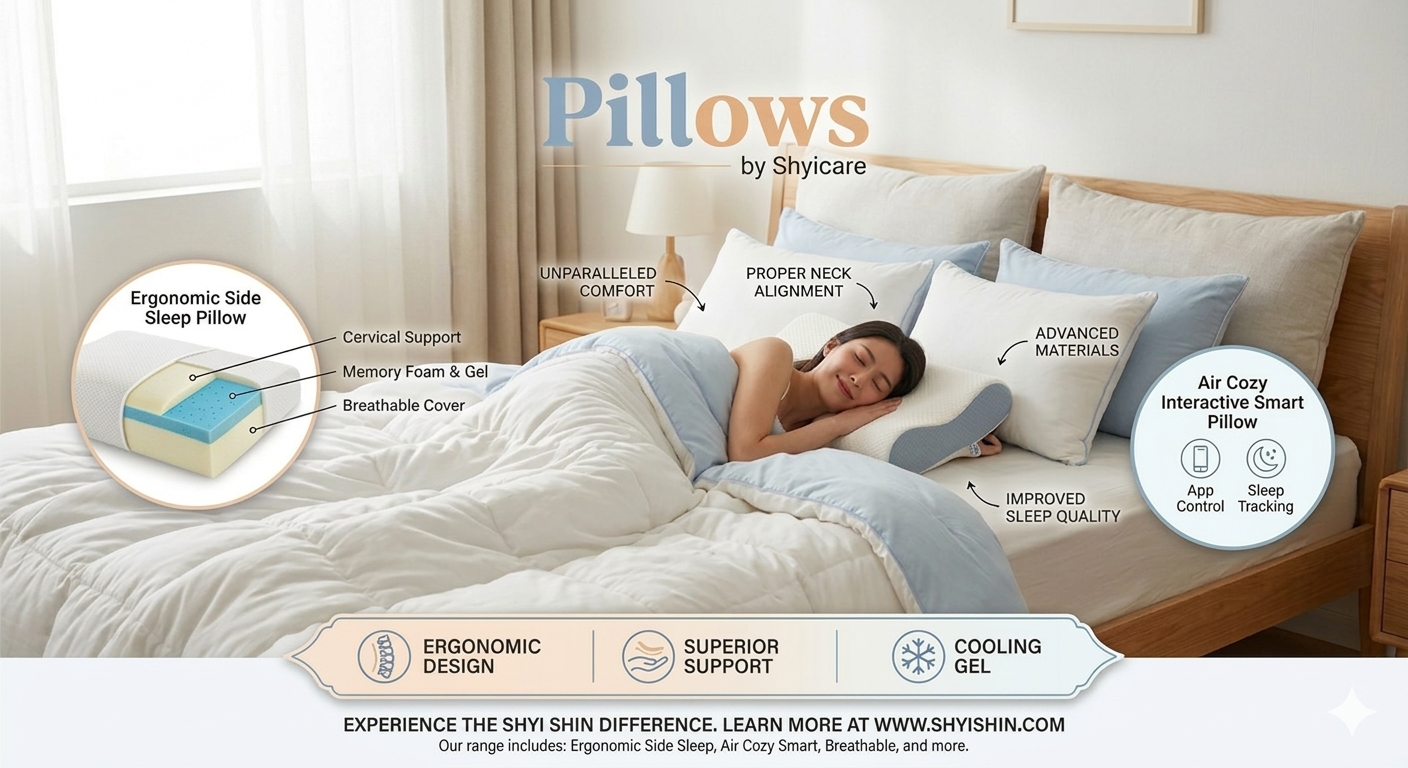
· Side Sleepers (60% of Population): Require a firm to medium-firm feel and a high loft (4 to 6 inches / 10 to 15 cm). This bridges the wide gap between the acromion process (shoulder point) and ear, preventing lateral neck bending. Example: The SHYICARE Ergonomic Side Sleep Pillow features recessed ear pockets to eliminate pressure points.
· Back Sleepers: Require a medium-firm feel and a medium loft (3 to 5 inches / 8 to 12 cm). The center should cradle the head while an elevated lower contour supports the neck's natural arch without forcing the chin toward the chest.
· Stomach Sleepers: Require a soft feel and a low loft (under 3 inches / 7 cm) or no pillow. Excessive loft in prone position causes severe cervical rotation and lumbar hyperextension.
Step 2: Select Materials Based on Health Goals
· For Cervical Pain: Opt for high-density, molded contoured memory foam engineered for structural cervical support.
· For Thermal Discomfort: Choose open-cell gel-infused foam paired with perforated airflow channels.
· For Sleep Quality Optimization: Select interactive smart tracking pillows to track sleep cycles and passive posture shifts.
Step 3: Hygiene & Cover Fabric Integrity
Select removable, hypoallergenic outer covers woven from high-breathability fibers like Tencel™ or bamboo viscose. Ensure an airflow rating that prevents moisture accumulation and dust mite infestation.
4. Pillow Lifespan, Folding Test & Maintenance
Over time, body sweat, dead skin cells, and physical pressure break down internal foam matrices and fill fibers.
· Replacement Timelines: Standard polyester fiberfill pillows degrade within 12 to 18 months. Premium high-density memory foam and ergonomic smart pillows from SHYICARE maintain structural integrity for 2 to 3 years.
· Signs You Need a Replacement: Waking up with persistent shoulder stiffness, tension headaches, or needing to manually fluff the pillow during the night.
· Care Best Practices: Use a water-resistant, breathable inner protector beneath your main pillowcase. Never submerge memory foam cores in water; spot-clean only and air out in a shaded, ventilated room. Wash outer covers every 1 to 2 weeks at 60°C to maintain optimal sleep hygiene.
Medical Disclaimer: This article is for informational and educational purposes only and does not substitute for professional medical advice, diagnosis, or treatment. If you suffer from severe chronic cervical spine conditions or nerve impingement, please consult a licensed healthcare professional or physical therapist.
How do I know if my pillow provides correct cervical support?
Perform a mirror alignment test or have someone take a side-profile photo while you lie in your primary sleep posture. Your nose, chin, sternum, and spine should form a straight horizontal line parallel to the mattress. If your chin tilts downward toward your chest or backward toward the headboard, your pillow loft is incorrect.
How often should I replace my pillow?
Polyester fiberfill and down pillows should be replaced every 1 to 2 years. High-density ergonomic latex or contoured memory foam pillows last 2 to 3 years with proper care. Replace any cushion immediately if it fails the fold test or shows unyielding lumps.
Which pillow type is best for side sleepers with neck pain?
Side sleepers with neck pain benefit most from a contoured, high-loft memory foam pillow featuring a shoulder cut-out. This design supports the neck arch while accommodating the shoulder width, stabilizing the cervical spine.
Do cooling gel pillows really regulate sleep temperature?
Yes. Phase-change material (PCM) gel layers absorb excess conductive heat from your head and transfer it away, maintaining skin microclimate temperature within the optimal thermal zone (