

Clinical data from the Association of periOperative Registered Nurses (AORN) consistently highlights that traditional foam options often bottom out during extended cases, leading to localized tissue ischemia. To solve this clinical challenge, healthcare facilities are increasingly turning to advanced patient positioning gel pads as part of their essential operating room table pads protocol. This evidence-based guide explores how to integrate viscoelastic gel positioners to safeguard patients during long-duration surgeries.
The Biomechanics of Perioperative Pressure Injuries
During long surgeries, tissue damage is primarily driven by three mechanical forces: pressure, shear, and friction.- Pressure constricts microvascular blood flow, leading to localized hypoxia and tissue necrosis, especially over bony prominences like the sacrum, occiput, scapula, and heels.
- Shear forces occur when bones slide against deep tissues while the skin remains stationary on the surgical table, stretching and tearing delicate capillaries.
- Friction damages the superficial epidermal layer, compromising skin integrity.
How to Use Gel Positioners to Prevent Pressure Injuries: Step-by-Step Clinical Best Practices
To achieve optimal clinical outcomes in long-duration surgeries, our clinical specialists recommend implementing the following evidence-based positioning protocols using specialized surgical positioning devices:1. Pre-Operative Assessment and Skin Inspection
Before transferring the patient to the OR table, conduct a thorough skin assessment using standardized scales (such as the Braden Scale). Identify high-risk factors including advanced age, poor nutritional status, diabetes, obesity, or vascular disease, which lower the threshold for pressure-induced tissue damage.2. Select the Right Gel Geometry for Specific Surgical Positions
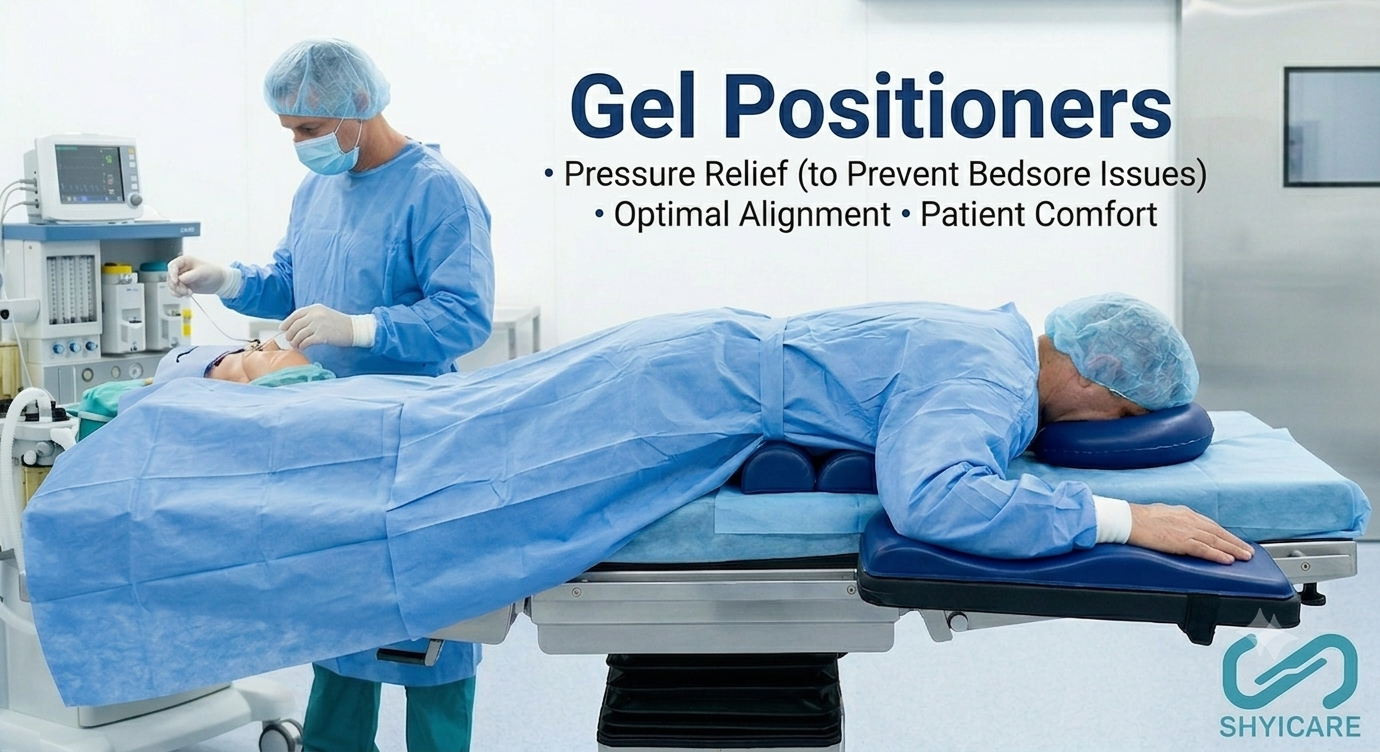
Different surgical postures require targeted anatomical support. For instance, in prone position surgeries (common in spinal procedures), the face, chest, and limbs experience severe gravitational pressure.- Head & Face Protection: Utilize a Gel Horseshoe Donuts Positioner Pad. The open horseshoe design cradles the patient’s face, mitigating pressure on the forehead, eyes, and jaw while providing clear clearance for endotracheal tubes and anesthesia lines. ``
- Torso & Respiratory Support: Position Gel Chest Rolls longitudinally from the clavicle down to the iliac crests. This redistributes the weight of the trunk, relieves direct abdominal and thoracic pressure, and ensures optimal diaphragmatic excursion and venous return. ``
- Upper Extremity Protection: Place arms on Contoured Gel Armboard Pads. The anatomical groove cradles the arm securely to prevent intraoperative slippage and delivers targeted pressure relief to safeguard the vulnerable ulnar nerve and brachial plexus.
3. Maintain Absolute Cleanness and Avoid Layering
One common error we observe in the OR is layering multiple cotton sheets, pillows, or unapproved blankets over viscoelastic gel positioners. Excessive layering causes a "hammocking" effect, which diminishes the pressure-redistributing properties of the gel. Ensure that skin makes direct contact with the pad (or a single, tautly pulled breathable barrier film approved by the manufacturer).4. Intraoperative Monitoring and Post-Operative Documentation
For surgeries lasting over four hours, microvascular occlusion risks increase exponentially. While the patient cannot be fully turned mid-surgery, clinicians should perform micro-adjustments where surgically safe, monitor distal pulses, and check alignment. Document the exact position, types of patient positioning gel pads utilized, and post-operative skin status immediately upon closure.Why Material Integrity Matters for Infection Control and Imaging
Beyond pressure relief, clinical best practices require that positioning devices support the overall workflow of the OR. High-quality surgical gel pads feature a resilient, puncture-resistant outer membrane. This membrane must be completely fluid-proof to prevent the absorption of blood, prep solutions, or bodily fluids, facilitating easy infection control via standard hospital-grade disinfectants between cases.Furthermore, the gel must possess X-ray translucency (radiolucence). This ensures that intraoperative fluoroscopy, CT scans, or mobile X-rays can be performed with absolute clarity, eliminating the dangerous need to lift or reposition the patient mid-procedure.
Optimize Your OR Safety with SHYICARE Medical Gel Positioners
Preventing perioperative pressure injuries requires a combination of clinical expertise and superior positioning technology. At SHYICARE, we engineer a comprehensive line of medical-grade, latex-free, and plasticizer-free gel positioners and premium operating room table pads tailored to meet the highest safety standards of modern surgical teams. From specialized horseshoe donuts to contoured armboards, our surgical positioning devices are clinically proven to enhance load distribution, maximize patient comfort, and eliminate HAPI risks in long-duration cases.Ready to upgrade your hospital's pressure injury prevention protocol?
Contact the SHYICARE Team Today to request a product sample, view our full surgical catalog, or speak with a clinical positioning expert about customizing a solution for your operating rooms!
Are SHYICARE gel positioners safe for patients with severe allergies?
Yes. All SHYICARE surgical gel pads are 100% latex-free, silicone-free, and plasticizer-free, making them completely safe for hypersensitive patients and preventing any chemical leaching during long surgeries.
How should medical gel pads be cleaned between surgical cases?
Our positioners feature a fully sealed, fluid-proof membrane. They can be easily cleaned and sanitized using standard hospital-grade disinfectants. Avoid autoclaving or submerging them in boiling liquids.
Do these gel positioners interfere with intraoperative imaging?
Not at all. SHYICARE gel pads are engineered with full radiolucent properties, ensuring artifact-free clarity during X-ray, CT, and fluoroscopy procedures.